
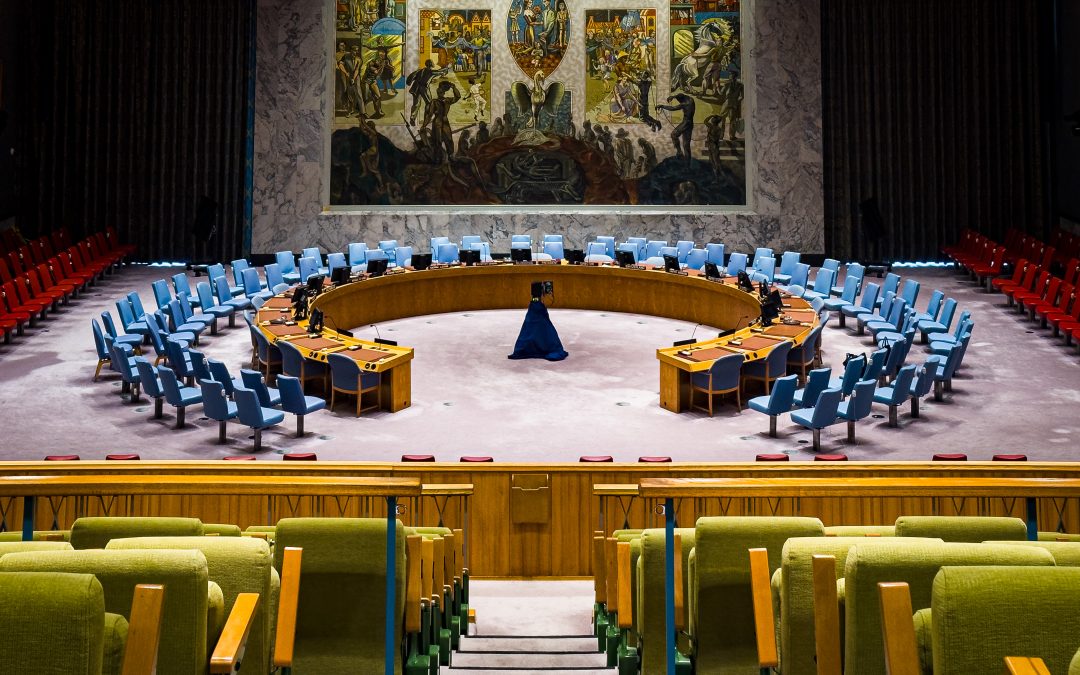
On 23 September 2026, French Foreign Minister Jean-Noël Barrot convened the UN Security Council for a high-level briefing on artificial intelligence and international security. The briefers were not ambassadors or defense ministers. They were Sam Altman of OpenAI, Dario Amodei of Anthropic, Yoshua Bengio of the International Scientific Report on Advanced AI Safety, and Clément Delangue of Hugging Face. The Council gave frontier-lab chiefs formal parity with the national delegations whose purpose is to maintain international peace and security. What the session produced was testimony, not text.
Altman's remarks, published by OpenAI, framed AI governance as a function of democratic institutions accountable to the people they serve. He emphasized three principles: AI systems must remain under human control, benefit people broadly, and empower individuals. The language is careful. It positions states as the legitimate rule-makers without committing OpenAI, or the Council, to the independent capability-threshold testing that the UN's own Digital@UNGA co-leads had proposed two days earlier. On 21 September, Paula Bogantes Zamora and Rebecca Finlay called in Fortune for new AI systems to be released only after independent testing against agreed capability thresholds. Altman's testimony did not engage that criterion.
CNN reported that both Altman and Amodei urged the Council to adopt international AI standards, without specifying whether those standards should include mandatory pre-deployment testing. The Guardian's coverage noted the novelty of corporate leaders addressing the Council but did not report any delegate moving to convert the Digital@UNGA roadmap into a formal presidential statement or resolution. The Security Council Report preview had treated the meeting as a briefing, not a decision point—and no post-session document has surfaced in the days since.
The European parallel is equally static. The EU AI Board's 17 September meeting produced no new deadlines, no mandatory benchmarks, and no testing thresholds for frontier models. Europe's Annex III high-risk system rules remain deferred to December 2027. No major regulatory framework has adopted the UN threshold language as a formal deployment requirement.
Meanwhile, California's AB 1883—which would bar employer AI collection of neural data—remains on Governor Newsom's desk with a September 30 signature deadline. MultiState's tracker notes that the bill is part of a broader legislative wave on AI in employment, but it is employment law, not AI safety architecture. It does not fill the gap the Security Council briefing left open.
What changed between 21 September and 23 September is measurable in rhetoric, not in rules. The Digital@UNGA co-leads gave the multilateral system a specific, testable commitment: independent threshold testing before release. The Security Council heard from the CEOs whose companies would be subject to such testing, and the Council chose to listen rather than legislate. This is not a failure of process—a briefing is what France convened—but it is a failure of acceleration. The threshold-testing proposal now has the shape of a norm without the mechanism of enforcement. Washington has already rejected multilateral oversight frameworks. The EU has deferred. The Council has briefed. The question is whether threshold-testing can survive as a legislative scaffold when every institution that could adopt it has chosen to defer, and whether the next Global Dialogue in Geneva can convert the co-leads' language from recommendation to requirement before the models they seek to constrain reach the next capability threshold.
Sources
– Security Council Report, "Artificial Intelligence: High-level Briefing" (What's In Blue, 2026-09)
– The Guardian, "OpenAI's Altman and Anthropic's Amodei address UN security council" (2026-09-23)
– CNN Business, "Sam Altman, Dario Amodei urge UN Security Council to adopt international AI standards" (2026-09-23)
– OpenAI, "Sam Altman's remarks at the United Nations Security Council" (2026-09-23)
– Quasa, "EU AI Board Meeting Added No New AI Act Deadline" (2026-09-17)
– MultiState, "State AI Employment Laws Address Monitoring, Hiring and Bias Concerns" (2026-09-21)