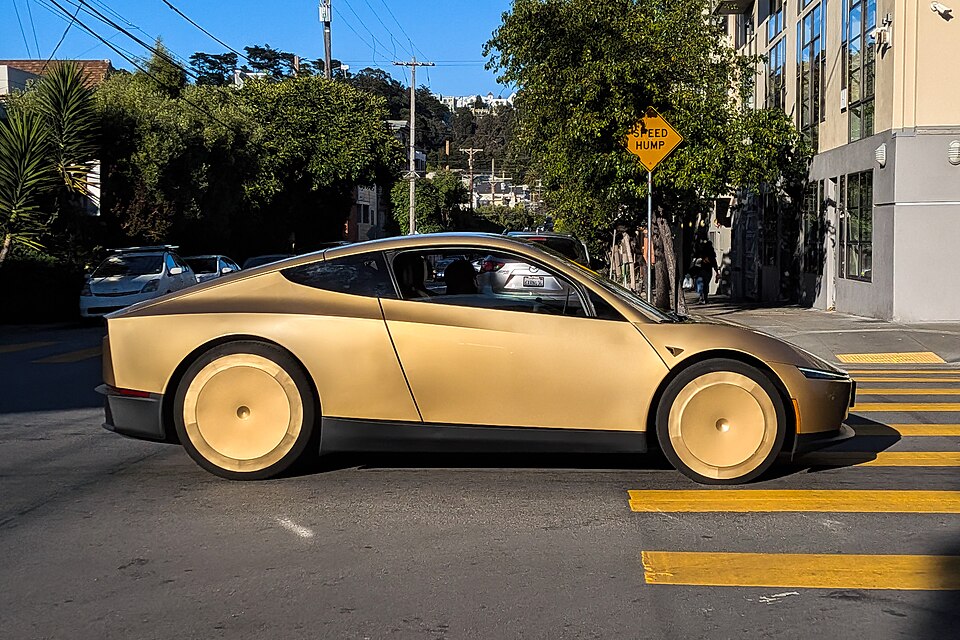
Tesla began offering Cybercab robotaxi rides in Austin on September 4, and by the following morning the National Highway Traffic Safety Administration had opened a probe into roughly 1,000 of the vehicles. The agency is auditing how Tesla self-certified compliance with federal safety standards for a vehicle that has no steering wheel, no brake pedal, no accelerator pedal, and no side mirrors. The question is not merely whether Tesla cut corners on paperwork. It is whether the corner exists at all.
The Federal Motor Vehicle Safety Standards were written around a single assumption: every vehicle has a human operator who can take manual control. When a manufacturer designs that assumption out of the vehicle, the standards do not clearly say what has been violated. NHTSA's recall authority requires a defect relative to an applicable standard. If no standard contemplates the absence of a steering wheel, then the absence of a steering wheel is not, strictly speaking, a defect under the current framework. The regulator is left holding a statute that assumes the problem it was built to solve.
This is not an oversight that better drafting alone would fix. The US auto safety regime is structurally reactive. Congress gave NHTSA authority to police defects in vehicles already on the road, not to approve designs before they reach it. That model works when manufacturers seek pre-market compliance as a matter of course. It frays when a company treats regulatory ambiguity as a product feature rather than a risk to mitigate. Analysts have described Elon Musk's approach as "creative interpretation": assert federal compliance, deploy at scale, and force the agency into years of post-hoc adjudication while the vehicles operate in public space. The strategy shifts the burden of proof from the manufacturer to the regulator and from the regulator to the courts.
The timing compounds the pressure. Tesla confirmed in its second-quarter earnings call that FSD version 15 is already running in early Robotaxi builds, even as NHTSA's engineering analysis into FSD version 14 covers 3.2 million vehicles for visibility-related crashes. The company is iterating its autonomous stack faster than the agency can close its investigations into the prior iteration. Meanwhile, Tesla is withholding FSD crash data from Illinois prosecutors in a fatal turn case where FSD was engaged, redacting the crash narrative, software version, and operating-area data. The parallel contests—civil regulatory audit, criminal discovery, and public deployment—are moving on different clocks, and the slowest clock belongs to the body with the most accountability and the least statutory leverage.
NHTSA could attempt to block Cybercab deployment, but its tools are blunt. It can demand recalls where a standard is violated; it can conduct audits where certification is suspicious; it cannot easily stop a vehicle class that sits in the negative space of the standards it administers. Proactive rulemaking would require the agency to write new standards for a technology that did not exist when the statutes were drafted, a process the US system structurally resists and Congress has not funded with anything like the urgency of the technology's rollout.
The tension is architectural. A regulatory framework built to catch defects in human-driven cars is being asked to govern vehicles designed to make the human redundant. Whether NHTSA can adapt its authority fast enough to matter, or whether the gap becomes the operating environment, is the question the Cybercab launch actually poses. The probe is a signal. It is not yet a answer.
Sources
- Tesla Cybercab is already under NHTSA investigation after launch, Electrek, September 4, 2026
- US opens probe into Tesla self-certification of Cybercab robotaxis, Reuters, September 4, 2026
- U.S. Feds open probe into Musk's steering-wheel-free taxis a day after he began offering rides in them, CTVNews (The Associated Press), September 4, 2026
- Tesla starts Cybercab rides in Austin, drawing US safety agency interest, Reuters, September 3, 2026.