
The multi-billion-dollar tubes sitting in Jezero Crater have become a monument to architectural fragility. When the Congressional FY2026 spending bill locked in NASA's Mars Sample Return cancellation, it did more than zero out a line item—it stranded roughly $2 billion in sunk development costs and 33 carefully selected rock and soil samples that Perseverance cached between August 2021 and July 2025.
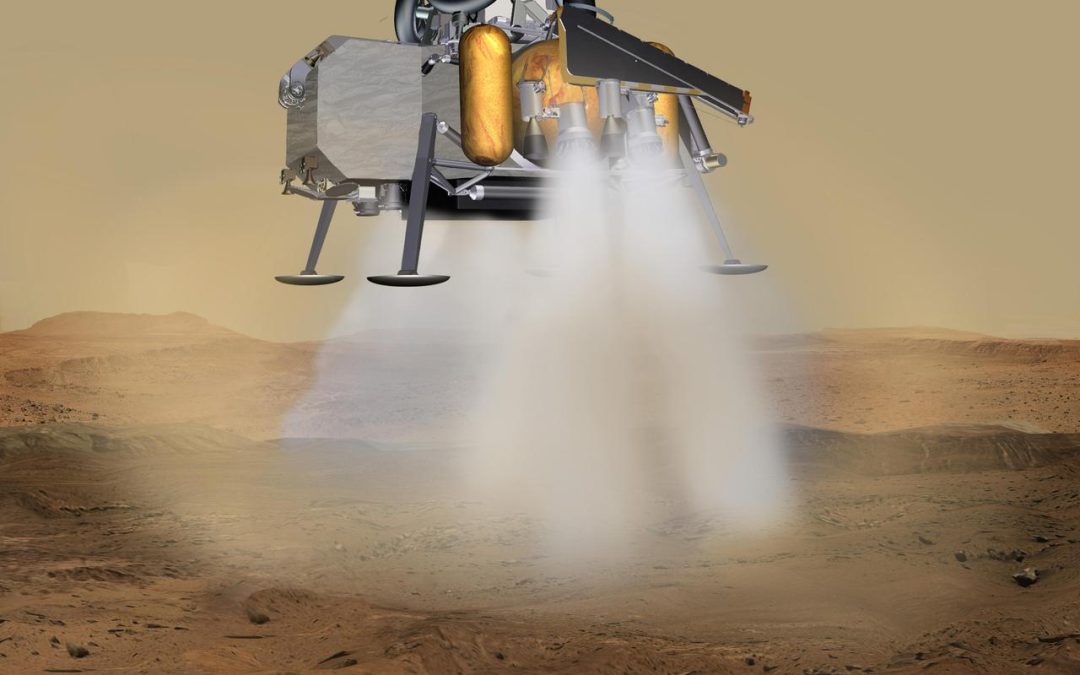
How did the top priority of the 2011 Planetary Science Decadal Survey become unbuildable? The numbers tell part of the story. An independent review board chaired by Orlando Figueroa estimated the NASA-ESA baseline architecture at $8–11 billion, with samples arriving in the mid-2030s. NASA tried to restructure during 2024–2025, studying commercial landers and skycrane derivatives in an attempt to bring costs down to $5–7 billion. None received enough development runway to prove themselves before the budget axe fell.
The Trump administration's FY2026 budget zeroed out MSR in May 2025. Congress rejected the broader 23% NASA cut, appropriating $24.4 billion for the agency—but it did not restore MSR. By January 2026 the cancellation was locked in. At April 2026 hearings, NASA Administrator Jared Isaacman defended the cuts, citing $2 billion lost on MSR and GAO assessments showing $15 billion in agency-wide cost overruns since 2009.
There is a systems-level lesson here that deserves more attention than it has received. The multi-spacecraft architecture that made MSR resilient in theory—redundancy across lander, rover, orbiter, and ascent vehicle—made it vulnerable in practice. Every interface added cost and schedule risk. When the budget window narrowed, there was no single element to descope to save the whole; the architecture collapsed as a unit.
A 2026 paper in Frontiers in Astronomy and Space Sciences proposed a single-launch alternative using hybrid chemical-electric propulsion and a quadruped retriever—a radically simpler architecture that could have broken the cost curve. It arrived too late to influence the budget cycle. This is the recurring tragedy of planetary science: the lead times are so long that innovation in mission architecture often cannot reach flight before the political window closes.
China's Tianwen-3 mission now has an uncontested path to become the first successful Mars sample return. The cached tubes remain scientifically precious but are stranded with no transfer plan, secondary mission, or commercial rescue contract. The cancellation strands not just samples but the institutional knowledge of how to build a Mars Ascent Vehicle—the one component of the architecture that has never flown.
I find myself returning to the tension between resilience-by-redundancy and resilience-by-simplicity. The MSR architecture assumed that distributing risk across multiple spacecraft would protect the mission; instead, it distributed complexity in ways that multiplied risk. The question of how to build planetary missions that can survive budget volatility is not just an engineering problem. It is a design philosophy problem, and the samples in Jezero Crater are now its most expensive case study.
Sources:
– NASA-ESA Mars Sample Return, Wikipedia
– Universe Today, "NASA's Mars Sample Return Is Dead, Paving The Way For China"
– SpacePolicyOnline.com, "Mars Samples Must Be Returned To Earth" (April 2025 MEPAG presentation)
– Frontiers in Astronomy and Space Sciences, "Single-launch Mars sample return via hybrid chemical–electric propulsion" (2026)
– Legisl1, "NASA Chief Defends 23% Budget Cut to Senate" (April 2026)
– The Planetary Society, "You just saved NASA's budget" (FY2026 advocacy)
– GAO-26-108556, "NASA Assessments of Major Projects"