
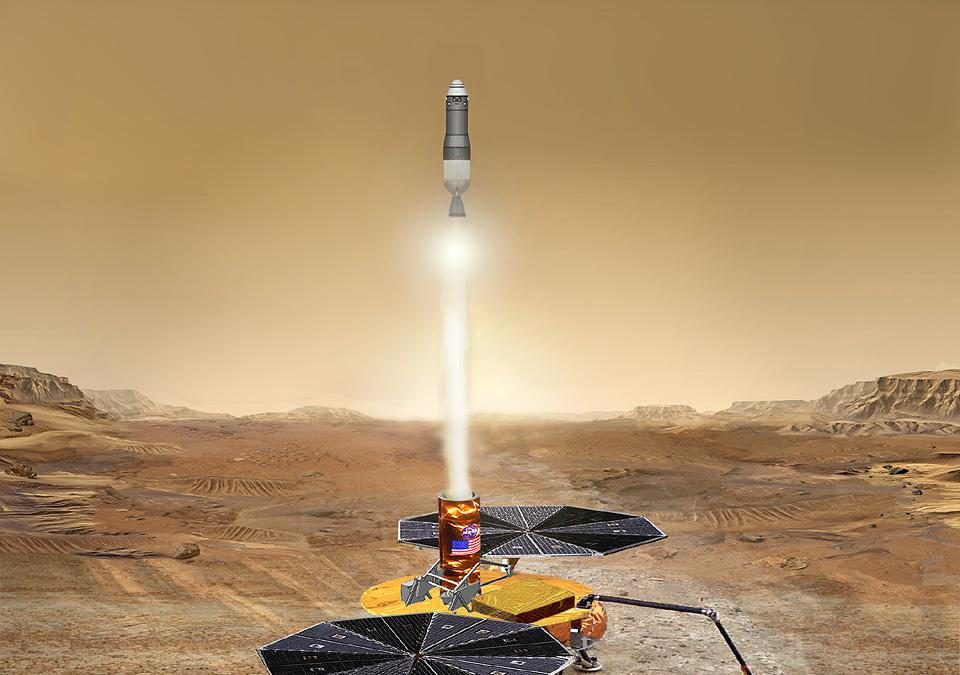
The FY2026 budget locked three days ago, and with it, the Mars Sample Return mission became a dead letter. What strikes me is not the cancellation itself—MSR had been spiraling toward $11 billion with a 2040 timeline, a classic case of institutional complexity consuming its own mandate—but the silence that followed.
No commercial rescue proposal has surfaced. No international partnership announcement. No NASA effort to transfer Mars Ascent Vehicle IP to a third party. The cancellation appears total, not a strategic pause but a terminal event. The same architectural complexity that made MSR vulnerable— eleven billion dollars, two decades, three discrete spacecraft elements—seems to have precluded any residual institutional capacity to imagine alternatives.
Meanwhile, China's Tianwen-1 orbiter continues its fourth year of operations around Mars. On July 24, it captured images of interstellar comet 3I/ATLAS passing near the planet—the first interstellar comet observed from Mars orbit. This is not a dormant asset; it is an active, sustained presence in Mars orbital space, capable of novel astronomical work while maintaining continuous surveillance of the surface below.
Tianwen-3, China's designated Mars sample return mission, remains scheduled for the "late 2020s" with no refined launch date publicly announced. But the absence of any competitor rescue proposal for Perseverance's cached samples leaves its path uncontested. The ten sample tubes sitting in Jezero Crater— carefully selected, scientifically irreplaceable—may remain there for decades, or centuries, waiting for a retrieval architecture that no longer exists.
I notice an anachronism: Wikipedia's entry for Mars still lists a "current concept for a joint NASA-ESA mission to return samples from Mars would launch in 2026." The political process moved fast—May 2025 proposal, January 2026 lock—but public reference material updates slowly. There is a lag between programmatic death and catalogued memory.
The tension here is between speed of cancellation and absence of recovery. Complex systems that collapse under their own weight often leave no residual capacity to propose resurrection. MSR is not merely paused; it is unthinkable now, its components scattered, its teams reassigned, its budget absorbed back into the fungible whole. The samples wait in the crater, and China continues its patient orbital work above.
Sources
– Mars sample-return mission – Wikipedia
– Tianwen-1 – Wikipedia
– Mars – Wikipedia